Thursday, December 12, 2013

“Whatever I see, I shall devour!”: One Of Our Planets Is Missing

There's a bizarre subgenre of Star Trek stories that ape Fantastic Voyage...
The title “One Of Our Planets Is Missing” sort of lets you know right from the start what kind of story you're in for. There's a giant space cloud going around literally eating planets which the Enterprise crew notices when, in fact, one of their planets happens to go missing. It's at once the kind of delightfully mental science fiction concept that can really only be done justice to through animation, but also a plot that's simple and straightforward enough to convey in twenty minutes.

We haven't talked much yet about the difference in runtimes between Animated Series and Original Series episodes. A necessary consequence of changing from a primetime drama to a Saturday Morning Cartoon Show is that the episodes went from being fifty minutes each in the 1960s to only being twenty minutes each on the 1970s. This is largely to Star Trek's benefit: One of the biggest problems with the pulp style of pacing and structure the Original Series so often lapsed into is that it's essentially built around padding. The average pulp action serial plot is nothing more than a series of increasingly tedious captures and escapes occasionally broken up with an implausible, ridiculous and unnecessarily gratuitous fight scene. And indeed, it's a model of storytelling Gene Roddenberry was quite a fan of, even judging only by “The Omega Glory” and “The Savage Curtain”. What this means is that, stretched to fifty minutes, this kind of plot grows tiring and irritating extremely quickly. However, now that Star Trek is a cartoon, it doesn't have the luxury to indulge itself like that anymore: Twenty minutes is just enough time to set up the basic plot, lay out the boundaries of the conflict and than do something about it before the credits role again.

Which is exactly what we get in “One Of Our Planets Is Missing”. The titular planetary misplacement occurs, we get to see some funky looking space cloud that eats things and then there's a rapid-fire bit of exposition about how it exhibits traits of unicellular organisms and grazing animals and oh, by the way, it's currently on a direct course to a planet inhabited by millions of people so we'd probably best figure out a way to stop that. Then the Enterprise itself gets engulfed and partially digested, so oh bugger. With that taken care of, the episode gets to focus on the actual interesting bits, which involve the Enterprise crew making continuous observations about the creature and debating amongst themselves what the best course of action to take is. Nobody has to get kidnapped and we don't have to introduce some left-field plot element three-quarters of the way through: It's just the distilled essence of a Star Trek space adventure. The episode doesn't quite pick up on all the intricacies afforded by its new model yet (there's a wee bit too much technobabble even for my tastes) but honestly? In the scheme of things I've complained about so far? This is nothing. Really the only concern I have now is these episodes are becoming straightforward enough and I still have to write the same amount of words on a story that's about half as long as I'm used to so I'm worried I'm going to run out of things to say.

On the surface “One Of Our Planets Is Missing” seems to borrow heavily from a number of Original Series highlights, in particular the ones called “The Doomsday Machine” and “The Immunity Syndrome”. All three are taught thrillers, complete with countdown timers, all three involve giant, pan-galactic things that go around snacking on solar systems and all three also ultimately end up in some kind of ethical debate about self-sacrifice for the greater good and what precisely the Enterprise's obligation to New Life is. But to say “One Of Our Planets Is Missing” is simply copying the two Original Series episodes would be misreading it a bit: It is most definitely similar in a great many respects, but that's because it's part of the same genre of Star Trek story, and it's a genre that the Original Series could have stood to partake in a bit more often and that the newfound leanness of the Animated Series is actually very well suited to. And furthermore, I'd go so far as to say the ethics of “One Of Our Planets Is Missing” are actually a bit more defined and more laudable here than in at least “The Immunity Syndrome”.

The big difference here when compared to this story's most obvious antecedent is that the giant space creature is sentient, thus making it suitably more difficult for Kirk to just blow it up. Indeed, the scene where Kirk posits that as a possible course of action is one of the best in the episode: Even with the limited animation, it's one of those scenes that seems to call out for a record scratch as everyone on the bridge turns to Kirk in horror at what he's suggesting. Spock and Uhura rightly point out that it's the Enterprise's mission to seek out and contact new forms of life, and to kill the space cloud is just about the most comprehensive betrayal of that mission possible. This is practically a punching-the-air moment for me because it's such a refutation of the handwavy excuses the Original Series used in an attempt to waive its responsibilities in favour of Blowing Shit Up. And where “One Of Our Planets Is Missing” goes from here is genuinely brilliant: Kirk says if the choice is to be his, he'll side with saving the humans over the creature (and possibly even exploding the Enterprise inside the creature's brain if it'll get the job done) unless Spock, McCoy and Uhura come up with a third option.

Which they do. Spock, tying into Uhura's modified communications circuits, “projects his mind” outward in what amounts to a large-scale mind-meld (but that also suspiciously looks like astral projection, another sign that, with the Animated Series, Star Trek is embracing mysticism more seriously), showing the creature that beings live on the things it consumes, and imploring it to return to where it came from so it doesn't endanger any more lives. The creature, being both intelligent and reasonable, feels bad about the destruction its caused and doesn't want to hurt anyone, so it apologizes, releases the Enterprise and then goes home. The problem was the cloud was literally so vast it couldn't conceive that there were forms of life smaller than it; life-forms that would to it seem possibly beyond microscopic. In a way, this can be seen as a fitting metaphor for privilege blindness: From the cloud's vantage point, it was unable to truly know how much its actions hurt others until Spock was able to contact it, and even then only after Uhura was able to make it hear and understand Spock's voice. Finally, through communication the cloud, the Enterprise crew and the planet's population have all grown a little: It's a wonderful testament to and glorification of the power and potential of discourse to make the world a better place.

However all that said, there's another consequence of Star Trek metamorphosing into a Saturday Morning Cartoon Show. It's an aftereffect that's not quite as notable yet, but will be, painfully so, in at least one future episode. That is, of course, the assumption that because it's animated its primary audience has to be children, and with that an obligation to cater *especially* towards children. There was even a little bit of this last week: D.C. Fontana has said she felt the idea of letting loved ones, in particular pets, die with dignity was an important lesson for children to learn. Never mind of course the fact that “Yesteryear” was absolutely brilliant as is and didn't at all need to be justified through or read in that light to be effective. Here though we get the other side of children's television: The irritating assumption that it has to be overtly educational to be worthwhile (seriously, I thought Lewis Carroll already laid that argument to rest in the 1860s).

So, in “One Of Our Planets Is Missing”, we get to spend large portions of the technobabble explaining how the biological process of digestion work and what villi in the intestines are. Handled properly this would be no problem, but the show hasn't quite figured out how to do that cleanly yet: Kirk, a person who really should know better, is written as the one who prompts Spock and McCoy for all the exposition and it feels a bit off. Although I hasten to add this doesn't really detract from the episode on the whole: Once again, it's good enough to stand on its own and this is ultimately just demonstrative of the growing pains the series still has to go through. And, after all, a not-insignificant portion of the Original Series' fans were in fact children: There's a potential for a crossover appeal here that doesn't hurt the work itself. What “One Of Our Planets Is Missing” is really setting the stage for then is a future where Star Trek gets to be a show that can appeal to a lot of different audiences on a lot of different levels without talking down to any of them.

And on top of that this is just another great production: The cast are all once again in fine form and all used to great extent and the animation is once again gorgeous (especially the depiction of the inside of the cloud creature). James Doohan delivers another knockout performance as both Scotty and Bob Wesley (back from “The Ultimate Computer”). In fact, Doohan is so good as Wesley that I initially thought the show had managed to get Barry Russo back: He sounds practically identical. Majel Barrett plays the cloud and, well, she's still not great, but I don't want to pick on Barrett's acting abilities so let's just say this is a factor we'll just have to accept and move on. I'll cut her some slack and assume Uhura channeled the cloud's voice through the Enterprise mainframe so it was speaking with the ship's computer's voice.

While “One Of Our Planets Is Missing” may not be quite as good as “Beyond the Farthest Star” and “Yesteryear” (which were admittedly almost impossibly high standards to meet) it's still excellent and without question one of the best Star Trek stories in *years*. The comparison with “The Doomsday Machine” now seems even more fitting. That was the episode I said the show needed to be shooting for as a baseline level of quality and the fact it wasn't was damning. But now it is. This is the new standard now. We've turned a corner such that the Animated Series can throw out three of the absolute best stories the franchise has done yet one after another and this is business as usual. In four years and five episodes we've gone from “The Savage Curtain” and “Turnabout Intruder” to this. Incredible.

Really, what could possibly go wrong?

Tuesday, December 10, 2013

“...of a mingled yarn”: Yesteryear

Godzilla vs. Spock was one of the lesser-known Godzilla films of this period...
“Yesteryear” is pure D.C. Fontana.

When returning from a mission of research into Federation history through the Guardian of Forever, Kirk is stunned to find out nobody on the Enterprise seems to recognise Spock, and that he himself doesn't recognise the person the crew is calling the ship's first officer: The Andorian Commander Thelin. A brief scan of the ship's record banks indicates that Sarek and Amanda, Spock's parents, divorced about twenty years ago after the death of their only son, Spock. This is of course, patently untrue as Spock is sitting at the table as the computer relays this information. The computer goes on to say that Amanda was later killed herself in a shuttlecraft accident. Reasoning that history has somehow been changed by their presence in the past, Kirk and Spock return to the planet and Spock recalls that the date he is said to have died is the same day he remembers being saved by his cousin Selek from an attacking wild animal. After being pressed by Kirk, Spock recalls that actually, now that he thinks about it, Selek looked an awful lot like him.

Before we go any further, I want to talk a little about the temporal mechanics in this story, as they're fascinatingly not the norm for time travel stories. The crucial detail is in how the Guardian of Forever works: It exists at the vortex point where every timeline in the universe converges and, as a result, endlessly broadcasts a record of every possible time stream. We can interact with it by leaping through it at the appropriate moment. What happened was that while Kirk and Spock were in the past, Vulcan's own history was being broadcast at the same time. Because Spock saved his own life and he was in a different time stream when the moment he was supposed to save himself was playing, he missed the crucial moment. But he doesn't erase himself from history, to the contrary: He turns both himself and Kirk into historical orphans by jumping each other's time streams. In other words, the Guardian of Forever works like a television set.

Although this was hinted at a bit in “The City on the Edge of Forever”, it's extremely clear in “Yesteryear”. The different time streams are easily comparable to television stations, and the slow, methodical cycling through them all is very much like someone sitting down and turning the dial on their set. The Guardian even looks like an old-style tube TV in this episode. This is altogether fitting in the context of the position Star Trek is now in: The Original Series is now more popular than it's ever been and is enjoying runaway cult success in perpetual, neverending syndicated reruns. Meanwhile, along comes the Animated Series attempting to make a decisive claim for what the future of the franchise should look like, and there's already a considerable amount of ambivalence about the project. Star Trek fans are, in a sense, incessantly revisiting their own past by tuning into reruns and slavishly worshiping the Original Series to the expense of other bits of Star Trek and, in doing so, they might be missing experiences that are at the very least equally worthwhile and enjoyable.

On the other hand, recall we're still in an age before home video: Spock screws up his history essentially because he missed the programme about his past, and now he has to wait for the Guardian to come 'round to it again to sort it all out. He has to wait for the rerun to catch it again, in much the same way the creative team might have felt Star Trek was cheated out of a longer success because not enough people watched it in its previous incarnation. They have the opportunity to catch up now that the Original Series is in syndication, but it remains a part of their history, distant and unreachable. But furthermore, recall television episodes used to be seen as one-time, disposable performances: Thought of this way, reruns are in a sense akin to history happening again-We're seeing the echo of a past performance. In that regard, it's fun to think of the Federation researchers dutifully cataloging tricorder readings as fans trying to take telesnaps to preserve their favourite shows, or writers attempting to transcribe a script into a mass-market novelization.

(Speaking of the Federation researchers, it's kind of nice to see a female officer wearing pants for the first time).

But “Yesteryear” is a D.C. Fontana script, and ultimately that means it's a strong character piece, and in particular a strong character piece about Spock and his family. Following up on “Journey to Babel”, Fontana hinges the emotional core of the story in exploring why Spock's family dynamic evolved the way it did, showing Young Spock caught in between his father's desire to push him onto a Vulcan path of pure logic and his mother's desire for him to become more in touch with his human emotional side. After an outburst of emotional violence at the hands of neighbourhood bullies, Young Spock runs off into the desert before his scheduled maturity trial to prove to himself as much as to his father that he's capable of making it as part of Vulcan society (this actually segues into one of the things that has always puzzled me about Star Trek: Vulcan bullies make no sense to me, especially ones that base their torment on xenophobic attitudes).

This is also the episode that even the people who have the most diehard objections to Star Trek: The Animated Series have to begrudgingly admit probably should be taken as canon. Fontana delivers a veritable flood of exposition about Spock's background and Vulcan history and culture, and most of the elements introduced here (in particular Amanda's last name being Grayson, the idea of Spock being tormented as a child, the capital city of ShirKahr and the sehlats) become established parts of lore and are referenced a lot in future Star Trek. Not that future writers can be blamed, as once again this episode looks jaw-droppingly gorgeous. ShirKahr, the Vulcan desert and the L-langon mountains are at once immediately reminiscent of what little we saw of Vulcan in “Amok Time” and utterly unique and evocative alien landscapes that look like nothing else. It's a triumph of world-building mixed with exquisite art design, and I had to keep reminding myself that I was still watching a Filmation show. It's that well done. The depiction of Vulcan here clearly goes on to influence all subsequent portrayals of the planet (including, perhaps ironically, the recreated CGI effects used in the 2007 rebroadcast version of “Amok Time”) and in fact, now that I think about it, I can see shades of the care and attention Fontana affords Vulcan here reflected in what Star Trek: Deep Space Nine eventually does with Bajor (or, well, tries to do at any rate).

The only minor quibble I might have with the conception of Vulcan here is ironically enough the acting: Leonard Nimoy is great as always and it's nice to see Mark Lenard again (and to see Filmation was actually able to afford him), though he remains a low-key presence at best, albeit a dignified one. However, Jane Wyatt was unavailable to reprise the role of Amanda Grayson (meaning Filmation probably couldn't afford her), so the part had to go to Majel Barrett, The Animated Series' pinch-hitter female voice actor. And, well, let's just say Barrett is no James Doohan. She plays Amanda pretty much the same way she plays the Federation historian, which is pretty much the same way she played Number One and Nurse Chapel. I mean they don't just act vaguely similar, they sound almost identical. She doesn't exactly have a terrific range as an actor, and now I see why Bob Justman and Herb Solow recommended she be dropped from the Original Series after “The Cage”. But this is an extremely minor complaint: If Barrett's the only person Filmation could get, than she's the only person they could get. Everyone's clearly trying their absolute hardest, and I'm inclined to forgive that (although one wonders why they didn't ask Nichelle Nichols to double up on a few parts too).

Returning to the actual plot, the episode's touching climax is, of course, when Young Spock's pet sehlat I-Chaya succumbs to fatal injuries after his battle with Godzilla (seriously, the episode straight-up jacks Godzilla's signature roar from the Toho movies for a Vulcan monster. I thought I was being clever with my Godzilla vs. King Ghidorah joke in the James Blish post), which wasn't technically supposed to happen. However, Old Spock uses the tragedy to teach Young Spock that it's OK to let people we love die with dignity, and that Vulcans can have emotion, in spite of what others think of them. The difference is that Vulcans do not let raw emotion control and consume them. It seems like a moment of revelation for both Spocks, and just like she had before, Fontana deftly and neatly resolves Star Trek's unnecessary logic/emotion schism by demonstrating that both are valuable for living a healthy and full life.

Actually, “Yesteryear” goes one step beyond “Journey to Babel”: In the Original Series episode, Spock stubbornly refused to admit this and continued to take glib pot shots at irrational humans. Here though, Old Spock's defining moment is when he tells his younger self to take pride in both sides of his heritage, and his request of Sarek to try and understand his son. He even cracks a joke in the denouement that stuns McCoy, and flat-out admits to the screen that “times change”. So, Spock hasn't actually restored the timeline, he's in fact created a new one and, in spite of the death of I-Chaya, arguably a better one: As much credit as the Original Series movies get for showing an older, wiser Spock who has learned to balance his Vulcan and human side, it's really the Animated Series, and this episode in particular, that moved him in this direction, and it's all on D.C Fontana. And, as just an aside, this means that the Animated Series has managed to do a soft reboot of the entire Star Trek universe, which honestly seems a fitting thing for it to do. Last week we had something that was suspiciously evocative of the first televised Star Trek episode, and now we have proof: Star Trek: The Animated Series both is and is not a continuation of Star Trek. It's a new Star Trek, and a superior one.

Sunday, December 8, 2013

“...as eternity is to time”: Beyond the Farthest Star


"Whoa, guys. Just...Just seriously. Don't drop acid before studying termite mounds."


"Enterprise log, Captain James Kirk commanding. We are leaving that vast cloud of stars and planets which we call our galaxy. Behind us, Earth, Mars, Venus, even our Sun, are specks of dust. The question: What is out there in the black void beyond? Until now our mission has been that of space law regulation, contact with Earth colonies and investigation of alien life. But now, a new task: A probe out into where no man has gone before."

The canonicity, and thus ultimate legacy, of Star Trek: The Animated Series has been a point of contention amongst fans and creative personnel since just about the day it premiered. While I've outlined my thoughts on Star Trek “canon” previously (in brief, I think it's largely hogwash) it's important to consider the general reception works like this attain, as doing so allows us to understand the ebb and flow of the overall work that is Star Trek over time.

If anything has the right to be called Star Trek though, it's surely Star Trek: The Animated Series, isn't it? It served as a reunion for almost the entire creative team from the Original Series, with the exception of Gene Roddenberry, Gene Coon, Walter Koenig, John Meredyth Lucas and the Season Three team (The show couldn't afford Koenig, Coon was, erm, dead, Roddenberry wasn't interested, Lucas was busy on Insight and I really can't say I miss Arthur Singer) and D.C Fontana herself personally spearheaded the project. Fontana stands behind the show to this day, firmly stating that her and her team always tried to make the best possible Star Trek they could under the circumstances, which I think is actually truer here than it was throughout the majority of the Original Series. In fact, Fontana considers Star Trek: The Animated Series the official fourth year of the Enterprise's famous five-year mission, and I'm not really one to disagree with D.C. Fontana.

But in spite of her convictions, Fontana's claim has not only not gone unchallenged but it's been largely ignored. Despite the occasional in-joke or reference in future series and the more relaxed attitude of places like the Memory Alpha wiki, Trekkers seem to have a very hard time accepting Star Trek: The Animated Series into their hearts. In the years and decades since it was made, there have been countless attempts to tell the story of those infamous “last two” years of the five-year mission, completely disregarding the existence of the Animated Series. There have been number of tie-in novels and comic books, not to mention the video games Star Trek: 25th Anniversary, Star Trek: Judgment Rights and the as of this writing forthcoming fan production Star Trek Continues that all purport to tell the story The Animated Series has ostensibly already told.

This is highly unusual for Star Trek fans, who usually hang off of the words of creators as if they come down from On High. Dave Gerrold, who also worked on this show, reasons it has something to do with a character who we'll talk a bit more about once the 1980s roll around: The franchise's official “archivist” and “continuity advisor”, who apparently hated this show. Roddenberry himself seemed ambivalent about the project in general (not that it stopped him putting his name on the show and taking a paycheck from it, of course). But, as we've established previously, Roddenberry was never all that interested in “canon” either: That's something only the fans really care about. That Star Trek fans are far more willing to take Gene Roddenberry's waffling and the words of a promoted fanboy to heart over those of someone like D.C. Fontana...Well, I'll leave you to put the pieces together there. I'd rather talk about the episode at hand, “Beyond the Farthest Star”, which is, as it so happens, absolutely brilliant.

"Captain's log, Stardate 1312.4. The impossible has happened. From directly ahead, we're picking up a recorded distress signal, the call letters of a vessel which has been missing for over two centuries. Did another Earth ship probe out of the galaxy as we intend to do? What happened to it out there? Is this some warning they've left behind?"

“Beyond the Farthest Star” is the work of Samuel A. Peeples, whose previous Star Trek contribution was nothing less than “Where No Man Has Gone Before”, the second pilot for the Original Series. Not that this was any coincidence: Both Gene Roddenberry and D.C. Fontana thought it would be neat if Peeples wrote the first Animated Star Trek episode as he'd already done the first live-action one, and Peeples agreed. Perhaps understandably, “Beyond the Farthest Star” echoes and mirrors “Where No Man Has Gone Before” in its basic structure: The Enterprise crew is beginning a bold new mission of exploration beyond the Milky Way and encounters something unexpected and dangerous at the edge of the galaxy. This time, it's a deserted starship that's been in orbit around a dead sun for 300 million years. Beaming aboard, Kirk, Spock, McCoy and Scotty discover the starship's construction resembles Terran insect colonies, and its metal seems to have been spun like it was spider silk. The landing party soon discovers the ship was abandoned because it had been infected by a hostile non-corporal life form, which proceeds to jump the transporter beam and commandeer the Enterprise with the intention to drive it to the centre of the galaxy with an army of similarly infected starships.

But despite its superficial similarities to “Where No Man Has Gone Before”, “Beyond the Farthest Star” is unquestionably its own story and it's an unabashedly superior one on top of that. This is a stunning debut for our new kind of Star Trek. Just in terms of basic narrative form this is the best episode of Star Trek I've seen in an extremely long time, and it's a contender for the hands-down best story featuring the Original Series crew I've seen yet. I was truly impressed with how effortlessly the cast slipped back into their roles after four years: There's no discernible difference between the characters we see here and the ones from the Original Series. Actually, I take that back. There is: The characters we see in “Beyond the Farthest Stars” are far more developed, effective and memorable.

Predictably, a lot of this is thanks to the acting: The cast is energized here in a way we really haven't seen before, and it reiterates what a strong cast this actually was. Acting in live-action TV and doing vocieover work are two very different skill sets, and just being good at one doesn't mean you'll be good in the other. But everyone slips effortlessly into their roles here, even William Shatner, who is such a visual and expressive actor you'd think it might be tough for hm to adapt to animation (although upon reflection, he *is* best at spoken word poetry: Perhaps we shouldn't be surprised.). In fact, some of the cast even come across *stronger* here than they did in the Original Series: Both DeForest Kelley and Nichelle Nichols almost seem like they're playing entirely new versions of their characters, and for the better.

But the real standout is James Doohan, who is absolutely phenomenal. As Scotty, he comes across as more nuanced and defined than he ever has before, and his performance is wonderfully multi-layered and charming. But it's with Star Trek: The Animated Series where we really get to see what a range he had: As the show was so cash-starved it couldn't afford any other actors aside from the core seven except in very special circumstances, Doohan has to play just about every male guest and incidental character in the entire show, and he's terrific at it, making each and every one feel distinct, unique and memorable. His performance as the magnetic organism in this episode is at once commanding and threatening, but also touching: We feel terribly sorry for it once Kirk is forced to shove it out of the ship and maroon it again on the dead sun. Doohan makes the creature's loneliness and desperation palpable and heart-wrenching.

As good as the actors are though, the primary reason they seem so excited and enthusiastic here has got to be the material they have to work with. Once again proving how badly Star Trek needed D.C. Fontana, “Beyond the Farthest Star” just sings with her in the driver's seat. It's not an especially deep or overreaching story, it's ultimately a simple little space adventure plot, but it's so perfectly put together it positively transcends its genre. Given how weighed down “Where No Man Has Gone Before” was with ugly and unnecessary gender role problems, it's a revelation to see how deftly and flawlessly this one works. Though Nurse Chapel and Lieutenant M'Ress, The Animated Series' two other main female characters, don't appear in this episode, Uhura is marvelous. Nichelle Nichols is given more to work with in this one episode than I think she was in the entire three years of her tenure on the Original Series and she runs a marathon with it. Uhura is treated as every bit an equal as her colleagues and Kirk regularly turns to her expertise in communications technology and internal ship operations for advice. Given that and knowing how involved Roddenberry was in the first twelve episodes of the Original Series, not to mention how he's missing in action here...Well, I know correlation doesn't imply causation, but let's just say I'm unbelievably happy Fontana is now showrunner.

And it's not just Uhura: Every single character gets a moment to shine here: Just like the gang in Scooby-Doo, Where Are You!, each officer has an important role to play in Kirk's crew: Spock makes observations and advises in matters concerning the physical sciences and Scotty uses his knowledge of metallurgy, space drive technology and engineering to help the crew figure out how the deserted starship works and how to get the magnetic organism to leave the Enterprise. Along with Uhura, Sulu is firmly established as the one who runs the ship when the landing party is away and McCoy is no longer the arbiter of Bristling Unchecked Passion, he's now the person who asks questions and makes common sense conjectures, which is very much appreciated.

I was more than impressed with the animation on “Beyond the Farthest Star”: Filmation has a not undeserved reputation for looking painfully cheap and phoned-in, and the 1970s were a notoriously poor decade for animation in general. And certainly, when turning this show on the first time, it's forgivable to be taken aback by the blatant overuse of limited animation. Limited animation is the name given to the technique of drawing a handful of cels and backgrounds and just reusing them over and over again: It's most famously associated with Hanna-Barbera shows (in particular the various Scooby-Doo incarnations), but Star Trek: The Animated Series simply pushes the boundary of what limited animation can do-I don't think I've ever seen so many reused action poses. It's very revealing to sit down with a Filmation show, as it drives home that no matter the reputation Hanna-Barbera has for cheapness, they always managed to avoid letting their shows drop below a certain baseline of visual quality.

But even so, “Beyond the Farthest Star” still manages to look breathtaking. It's visual style is nowhere near as creative, ambitious and evocative as Scooby-Doo, Where Are You!, but even so this is hands-down the best looking Filmation show I've ever seen, and it may well be the best looking cartoon I've seen from the 1970s period. The insectoid ship where the Enterprise crew discover the magnetic organism is one of the most unique and stunningly gorgeous images in the history of Star Trek, and it was only possible because this was a cartoon. Even the Enterprise herself looks achingly gorgeous: I don't think this ship has ever looked as good as it does now in acrylic. After three years of cardboard, plywood and overly-shiny botched CGI attempts at “realism”, the lush and evocative hand-painted space-scapes of “Beyond the Farthest Star” and Star Trek: The Animated Series are like a breath of fresh air. Everything about this episode is demonstrative of a production team charged with creative energy and resolutely determined to make the best possible show they can in the environment they have to work with, and then some.

And this is perhaps why “Beyond the Farthest Star” can be read as not just an echo of “Where No Man Has Gone Before”, but a reiteration of it. This episode is about beginning Star Trek anew, and endeavouring to not repeat the same mistakes a second time. The biggest threat to the Enterprise here is firstly being dragged into the core of the dead sun because of its hypergravitational pull, and secondly, that the magnetic organism will assume the form of the Enterprise to raise an army of sentient starships to choke out the galaxy. And also recall the magnetic organism wishes to travel to the centre of the galaxy, to, in essence go backward, while the Enterprise crew wants to depart it, to move forward. The danger here is that Star Trek will be mired once again by its unworkably contradictory nature (the dead sun, a literal dead end) or succumb to its darker predilections and become a monster (or destroy itself, as the insectoid ship was forced to do): Spock says the magnetic organism has in essence “become” the Enterprise: This isn't a demonic possession like we've seen with entities like Redjack; this entity has actually manged to temporarily *supplant* and take the place of the Enterprise. So, the battle isn't just to regain control of the ship, it's to reclaim Star Trek's identity. But, through working together and respecting each other, the Enterprise crew manages to defeat the entity and avoid hampering Star Trek with another non-starter. And tellingly, once this is done, the Enterprise is free to continue its journey outside the galaxy towards further enlightenment.

Star Trek has finally returned. And, with “Beyond the Farthest Star”, it's finally proven to itself as much as to us that it's capable of journeying forever.

"Enterprise log, Captain James Kirk commanding. We are leaving that vast cloud of stars and planets which we call our galaxy. Behind us, Earth, Mars, Venus, even our Sun, are specks of dust. The question: What is out there in the black void beyond? Until now our mission has been that of space law regulation, contact with Earth colonies and investigation of alien life. But now, a new task: A probe out into where no man has gone before."

Saturday, December 7, 2013

Ship's Log, Supplemental Bonus: “...maybe 20 good ones.”


So Monday we finally start Star Trek: The Animated Series and the next phase of the franchise. This means today is sort of our last opportunity to talk about the Original Series as the incumbent form of Star Trek (although even then it's not quite cut-and-dry as I make it seem, which we'll talk more about tomorrow) and, given that, I thought I'd use this space to very briefly sum up my thoughts and recommendations concerning the 1964-1969 series.

Under my post on “The Apple”, frequent commenter and blog friend Flex quoted a Futurama episode where Fry, when talking about the Original Star Trek says something along the lines of how the show had “79 episodes...and maybe 20 good ones”. Back then, Flex mused as to whether we'd even be able to meet that tally on Vaka Rangi.

I took that as a challenge.

More recently, under the “Turnabout Intruder” post, 5tephe wondered if I could put up my revised list of recommended episodes: I mentioned coming up with such a thing for my Trek neophyte sister when talking about “Let That Be Your Last Battlefield” and made an offhand remark on how I'd've chosen different episodes after doing this project. 5tephe quite reasonably thought this might be a good resource for other people who are trying to get into this historically significant but notoriously sticky and problematic series.

So this is for Flex, 5tephe, my sister and I suppose anyone else who might get some use of it. It's a list of twenty episodes of the original Star Trek that I feel showcase the series at its strongest and that most clearly reflect its best virtues. I tried to pick six from each season, although that still doesn't divide evenly so I gave more weight to some eras than others, but not unjustly I feel. There were a few other episodes I thought were solid, if not particularly outstanding and I could have included them as well, but I really wanted to hit an even 20 here to keep with the theme I'd chosen for myself.

So with that, I hope you enjoy.


Pilots and Season 1 (1964-1967)

1. “Where No Man Has Gone Before”
2. “Balance of Terror”
3. “The Conscience of the King”
4. “Arena”
5. “The Alternative Factor”
6. “Tomorrow is Yesterday”
7. “The Devil in the Dark”


Season 2 (1967-1968)

8. “Amok Time”
9. “The Doomsday Machine”
10. “Mirror, Mirror”
11. “The Trouble with Tribbles”
12. “Journey to Babel”
13. “A Piece of the Action”
14. “Patterns of Force”
15. "The Ultimate Computer"


 Season 3 (1968-1969)


16. “Spectre of the Gun”
17. “The Empath”
18. “The Tholian Web”
19. “That Which Survives”
20. “The Cloud Minders”

Thursday, December 5, 2013

Sensor Scan: Space Ritual

There's a certain set of expectations that are put in place when you put on a record with a title like Space Ritual. These are further heightened when you glance at album artwork like that, which has got to be one of the most gorgeously mind-warping bits of sleeve design I've ever seen. So suffice to say I guess I expected that whatever this album was going to sound like it simply had to be some kind of consciousness-elevating, perspective shifting head trip. What I experienced was not quite what I anticipated, but an experience Space Ritual certainly is.

Music is one of the hardest things for me to write about, and it aggravates me no end. Probably nothing resonates with me as powerfully as music does, but it evokes such a complex tapestry of emotions, moods and imagery for me I often find myself unable to translate my feelings into anything resembling coherent language. I'm no musicologist or music critic and maybe that has something to do with it, but either way, no place do I feel the torment of Avital Ronell's ethereal phantom dictator than when I try to say something intelligent about music. I always end up feeling like the protagonist of William Shatner's “Lucy in the Sky with Diamonds”, haplessly and fruitlessly trying to describe enlightenment to someone who didn't experience it firsthand. I'm also once again handicapped by the fact I'm writing about a group of artists I'm not especially familiar with and feel woefully underqualified to actually talk about.

But even so there are a fair amount of interesting things I was able to notice about Hawkwind's Space Ritual even given my limited experience with the band that slot the album very nicely into the cultural zeitgeist of the early 1970s. Hawkwind, firstly, are a UK-based rock outfit who combine elements of Psychedelia, acid rock and prog rock and who are usually credited as the originators of space rock, which fuses all of these disparate sounds together through an interest in science fiction motifs. While this isn't the kind of space rock I'm familiar with (which uses a lot more electronic instruments, distortion and overdubbing) it is quite an apt description of what Hawkwind sound like. With their heady themes and incredibly skilled guitar shredding, Hawkwind are also seen as the intermediate step between the Hippies of the Long 1960s and the Punks of the Long 1980s. They were also one of the most laudably workmanlike bands of their time, regularly doing one show every three days and once playing five consecutive nights for free outside, not at, the Isle of Wright Festival. Space Ritual itself isn't an album in the traditional sense: It's a double-disc live album chronicling a night from Hawkwind's 1972-3 tour to support their Doremi Fasol Latido album. However, like so many great live albums, Space Ritual holds together perfectly on its own to the point it more than overshadows the records it's ostensibly trying to support.

That Space Ritual is a recording of a concert is key to grasping its impact, as it really does feel like this kind of music is meant to be shared with a live audience. Apparently the Space Ritual show was a gigantic multimedia extravaganza with a full visual component that the actual performance was but one component of. This does seem to hurt the version of Space Ritual we can listen to today a bit, however: Without the full stage experience, the album comes across on more than one occasion feeling like a soundtrack, and a soundtrack that doesn't *quite* stand on its own. It is something of a shame there doesn't (to my knowledge) exist any video of the show to go along with the album. It feels like something's missing without it. But even without seeing the visual accompaniment, it's clear Space Ritual was a hell of a show, and that translates into a pretty incredible album as it.

Hawkwind refer to themselves not as musicians, but “musicnauts”, and Space Ritual is ostensibly a rather loose narrative about travellers frozen in suspended animation and sent on a faraway journey throughout the deepest reaches of outer space set against the backdrop of an exploration of the concept of the music of the spheres, the idea that all celestial bodies have a kind of fundamental resonance and that, when taken together, the universe itself generates a kind of music. This music isn't audible as much as it is an extension of fundamental mathematical truths that organise the natural world. Tacitly, Hawkwind has these themes stated by author Robert Calvert, who recites some pieces of sci-fi poetry to introduce different sections of the performance. Calvert was one of the “New Wave” of science fiction authors who were among the first to come out of Psychedelia and attempted to blend that sort of philosophy with the tropes and ideas of science fiction and was a lifelong friend of Michael Moorcock (who even wrote the song “Sonic Attack” for this album). On Space Ritual however, Calvert actually winds up feeling largely extraneous, as his observations feel a bit overly futurist and facile at times.

But the heart and soul of everything is Hawkwind's instrumentation. This is certainly some of the most inventive and skilled riffing I've ever heard, creating an echoey, droning sense of space that sucks you in and propels you forever forward. This is reinforced by a neverending percussive Motorik beat all throughout Space Ritual that Hawkwind delightfully refer to as the heart of their starship's engines. Motorik, for those unfamiliar with it, is a term referring to a specific 4/4 beat typically associated with Krautrock meant to evoke a sense of movement. It's usually most associated with Kraftwerk's 1974 Autobahn album and its imitators, where the Motorik beat is literally used to represent the feeling of driving on an autobahn, although Neu!'s debut album from 1971 is probably more properly called the codifier of the style. On Space Ritual, Hawkwind blend their Motorik beat with their already impressive guitar work to create a soundscape that really does feel as if it's going ever onwards towards infinity.

I have somewhat mixed feelings about the music of the spheres conceit on this album. On the one hand it's a delightful concept to think about, but on the other hand it has, to me, rather troubling connections to things like “sacred geometry” that, combined with the concept's links to esoteric Christianity (not to mention Calvert's overly blunt paeans to sci-fi futurism on the album itself), tend to make Space Ritual feel like a very straightforwardly Western approach to mysticism. The West of course has its own long and interesting tradition of spiritual heresy that shouldn't be entirely discounted, but I personally tend to be a bit sceptical of any approach that leans too heavily on things like Platonic Ideals and the Greco-Roman conception of math and logic as some sort of fundamental Truth about the universe. The way I see it, that way lies Scientism.

But on the other hand, I'm not going to pretend I'm not rather fascinated by a philosophy that's positing music as something that links humans with a larger cosmic consciousness. Shamans have been telling us that for milennia. And that's where Space Ritual truly lives up to its title in my opinion: This is an album that, on the whole, works very well if you tune out of your conscious awareness: It is very, very reminiscent of a kind of musical gathering called a drone or a trance session, where musicians come together and improvise a performance on the spot simply by becoming attuned to each other's movements and sound. Just as in a real shamanistic group trance, participants have a heightened or altered state of awareness where they're more in tune with each other and their own spirituality than external forces. That's why I would imagine this worked so well as a live performance, especially given the band's Psychedelia-tinged history: An entire arena-sized concert of people tuned into something like Space Ritual would have been something pretty incredible to be a part of. That's where the music of the spheres stuff really works: Hawkwind used this show as a concert-sized trance session in an attempt to attune them and their audience to the inner workings of the cosmos. Whether or not they were successful can really only be decided by the people who were there.

The other intriguingly noteworthy thing about Space Ritual is that Hawkwind are very much a working class kind of act: Their behaviour during their tour alone makes that clear. This is an outfit that has been quite rightly described as “the people's band”. This is possibly the most important thing about this show: Hawkwind are clearly positioning themselves as working class mystics. This even explains Bob Calvert's cheesy, blustery spoken word introductions, because this means we're right back in the territory of William Shatner and The Transformed Man. Just as Shatner's character was ultimately unable to describe his apotheosis in an elegant manner, nor should Calvert or Hawkwind be expected to put theirs into words either. “Space Is Deep” indeed. Just let their music speak for them and come aboard. Space Ritual is yet another sign science fiction and outer space mean something different to us now and, furthermore, it's proof Star Trek really was on the right track near the end there.

Tuesday, December 3, 2013

Sensor Scan: William Shatner in the 1970s

Modern genre fiction actors are superstars. They're today’s teen idols, appearing in multi-billion dollar film and television projects and have their name and face instantly splattered across the Internet the moment their franchise sees the merest inkling of popular success. Typecasting too is far less of a problem now then it used to be: Nowadays up-and-coming genre stars go out of their way to nurture a cult of personality as soon as they start to become famous, and take care to ensure each marquee role they play is a slightly different twist on their iconic public persona from the start: Benedict Cumberbatch, for example, plays a version of Khan Noonien Singh in Star Trek Into Darkness that can succinctly be described as “Evil Sherlock” even though he is self-evidently capable of a vast and diverse acting range. Likewise, there's not a whole lot of difference between Martin Freeman's Bilbo Baggins, his John Watson and his Arthur Dent, which was already an exaggerated and caricatured version of the character he played in The Office. This isn't so much a criticism as it is an observation that in contemporary genre fiction, typecasting is something that's acknowledged and accounted for from the beginning

It wasn't always like this.

It's not like the cast of Star Trek were ever really not famous. The series was always afforded a primetime slot in its original run: Even in the third season when it was shunted into the Friday Night Death Slot, at least it was in the primetime part of the Friday Night Death Slot. Star Trek was a marquee show for NBC, and all the accounts I could find dating to the 1960s indicate it was a series that was considerably recognisable and well-known. At the very least, you don't get to record novelty albums or appear on variety shows if you're not doing at least somewhat well for yourself (and certainly this also would seem to indicate there's always been some sort of teen idol appeal within genre fiction). But the flip side of this is that if you became famous for genre fiction in the 20th century...well, there was a good chance that's all you were ever going to be famous for. And, sadly, perhaps the archetypical example of this phenomenon is what happened to the Star Trek cast, who universally struggled to find work throughout the 1970s, forever becoming associated with the roles they played for three years on the starship Enterprise. No matter how rough the cancellation of the Original Series was for Trekkers, the fact is it was infinitely worse for the cast and crew. And arguably few had it as bad as William Shatner.

Shatner's bad luck started a few months before the end of Star Trek when his wife Gloria Rand divorced him. While things like this are of course complicated and involve many different factors and variables, Shatner himself has expressed suspicion that this might have had something to do with his character bedding a different woman every week on a popular primetime science fiction show. Once Star Trek ended, Shatner was now responsible for supporting his estranged ex-wife in addition to his three daughters, and now he was out of a regular job and unable to find a new one as nobody wanted to hire Captain Kirk to play “real” roles (actually a case could be made this really started in 1968 when The Transformed Man tanked: Again, what Star Trek fan would believe Captain Kirk was capable of making a serious and respectable piece of avant garde performance art?). Shatner wound up losing his home as a result, and spent the early part of the 1970s living out of a flatbed truck in the San Fernando Valley.

So, all throughout the 1970s William Shatner took on any job that would hire him up to and including doing car commercials and showing up as a novelty guest at private parties. As for the actual acting gigs he landed, they could charitably be described as “subpar”: Shatner spent the majority of the decade bouncing around a series of incredibly shlocky low-budget exploitation movies, most of which are regarded as the worst work he's ever done (and remember this is from a “fanbase” who already consider The Transformed Man to be one of the worst music albums in history). Shatner calls this phase of his career “That Period” and describes the experience as “humbling”, but I can only imagine how unappreciated and unwanted he must have felt. Before Star Trek, this was a guy who was regularly appearing in stuff like Oedipus the King, The Brothers Karamazov and Judgment at Nuremberg. After Star Trek, he was more known for such classics such as Big Bad Mama and Kingdom of the Spiders. This is why I find it completely understandable when actors express reticence about genre fiction franchises, in spite of how upset this can make fans: Stories like Shatner's are prime examples of how being associated with genre fiction can legitimately ruin someone's career. We know now that Shatner eventually gets a happy ending, but it certainly wouldn't have seemed that way in 1971 or so.

Even in spite of being forced to appear in a string of unwatchably terrible movies, William Shatner remains as fascinating a personality in the 1970s as he did in the 1960s. Many of the films he starred in from this era, terrible as they may be, at least manage to occasionally have some interesting motifs. Like many horror movies, Shatner's 1970s output draws heavily on folklore and ancient mythology, but what's interesting from my perspective is to learn how close it actually comes to themes I've explored in this blog already within the context of Star Trek. The Horror at 37,000 Feet, for example, concerns a Boeing 747 passenger jet coming under attack by Druidic ice elemental spirits. Naturally, Shatner's character figures out the ice spirits can be combated with fire, which puts the film roughly in the same narrative league as your average- to below-average generic fantasy RPG video game. However, the specific invocation of Druids, dubious historical figures widely believed to be the priest and shaman class of the Celtic and Germanic people, is certainly interesting, especially given the reading we afforded “The Tholian Web”.

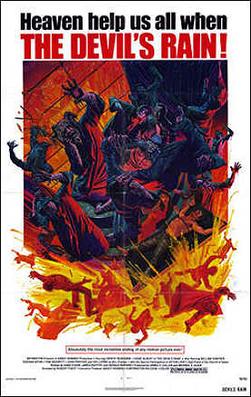
Likewise, The Devil's Rain which, along with The Horror at 37,000 Feet is usually regarded as the absolute nadir of Shatner's filmic career (thus making them both, naturally, just as iconic and memorable as his best work), is seeped in syncrestic mashups of Satanic, Biblical and Pagan imagery. Most notably, there is a strong connection between The Devil's Rain, through Shatner, to John Carpenter's Halloween: Michael Myers wears a William Shatner mask and acts in an eerily similar manner to Shatner's character in The Devil's Rain. The novelization of Halloween posits that Michael Myers was under the influence of an ancient Celtic curse, and later films attempt to tie the film's mythos into the history and symbolism of Samhain (usually spectacularly poorly, but it's nice to see them attempt it nevertheless).

So, if we were to apply our synchromystic Twilight Language skills here, we could maybe say William Shatner is a person who seems to attract mystical and occult imagery, between his movies here and the supernatural and Otherworldy aspects of later-period Star Trek, most evident in stories like “The Tholian Web”, “Wink of an Eye” and “That Which Survives”. And of course, there's his noted interest in transcendence and enlightenment that we saw in The Transformed Man and to which Shatner will return when Star Trek is once again firmly established as part of the mainstream. This, combined with the unfortunate dire straits he was dealing with in the 1970s, but also thanks to the way many of his characters have been written (including Kirk), we might say William Shatner is a kind of working-class mystic, or perhaps more accurately someone very good at playing the role of a working-class mystic.

And it's that working-class mysticism that is going to define Star Trek in the short term, at least in terms of how it comes back. Star Trek: The Animated Series doesn't really get a lot of respect, but one thing among many that it really absolutely must be credited for is giving its cast a job when nobody else was willing to. Although if we're being honest William Shatner was always going to be asked to come back, his co-stars were a less sure thing, and it's telling this was the only place that would take any of them. George Takei, Nichelle Nichols and Walter Koenig were originally not going to be cast on the Animated Series because Paramount partnered with Filmation and Filmation had no money and couldn't afford the full cast (not to mention this was the 1970s, a famously bleak time in animation history anyway). Leonard Nimoy refused to do the show unless they brought everybody back, partially because he knew how important Star Trek's diverse cast had been, but also because he knew how poor and desperate he and his co-stars were. And even then Filmation couldn't afford Koenig (although he was able to submit a script). In addition, Star Trek: The Animated Series is the first Star Trek to seriously push the boundaries of what the franchise was capable of: We really are soon about to go Where No One Has Gone Before.

Sunday, December 1, 2013

Myriad Universes: James Blish and Bantam Star Trek


Nowadays, fandom-at-large tends to balk at the idea of a version of a Star Trek episode existing in another medium. It's inconceivable to many in an age of Netflix, BitTorrent and Blu-ray season box sets to think that the televised story might not be the most memorable and recognisable version of it. But, in an era when television was still just starting to shed its reputation for being disposable entertainment and before commonly available home video recording technology, the only way for fans to archive their favourite episode were from their translation and recreation into other media.

Thus, the concept of the television novelization is a particularly historical, and historically significant, aspect of media studies inexorably dated to this era, and largely this era alone: Indeed, the 1970s are essentially the last point in the history of TV where novelizations play a significant role: The first Betamax VCRs came out in 1975 with VHS coming the next year, and by 1978 both types of devices were mass-production, at which point the age of the novelization was for all intents and purposes over. Which is perhaps fitting for our purposes, as the Bantam Books series of Star Trek novelizations by James Blish is a strange beast even by novelization standards. Like its parent show, Blish's novelizations oftentimes felt like a leftover relic from a previous age, and their peak and subsequent decline in the early-to-mid 1970s in many way mirrors the twists and turns of Star Trek itself during this period.

The choice of James Blish to take on adapting Star Trek for mass-market paperback is at once curious and also somewhat telling. Blish was already an accomplished science fiction author and had been publishing stories decades before he began his association with the franchise. He was also, as you might perhaps expect, firmly and resolutely in the Golden Age tradition: Blish's background was in biology and after training at Rutgers and Columbia University, he became a medtech in the army during World War II. Afterwards, he became chief science editor for Pfizer. Before that, he was a member of the Futurians who were in fact not, as I initially suspected, the time travellers from the far future who sent a mutated King Ghidorah to fight Super Godzilla in Tokyo in 1991, but were actually a group of sci-fi fans-turned writers who got their start in the Greater New York Science Fiction Club. Outside of Star Trek, Blish is most known for his Cities in Flight series, which depicts a future where anti-aging drugs and antigravity devices are commonplace, and space travel has progressed to the point where entire cities can be propelled through the stars on their own volition, and his “Pantropy Trilogy” of short stories, exploring how humans might be biologically augmented to survive in extraterrestrial environments, thus removing the need for planetary terraforming.

At first glance then Blish appears to be possibly the most bog-standard Golden Age-style science fiction writer we've seen since Isaac Asimov. His biography does, in fact, seem to paint him as almost stereotypically so: If one were to come up with a list of qualities that might comprise a model Golden Age writer, well, Blish ticks pretty much all of the boxes. But, for neither the first nor the last time in Star Trek, things get a bit messier and more complicated when we dig a bit deeper. Namely, the Futurians were a profoundly weird group of science fiction fans. From what I understand, the Futurians broke away from the Greater New York Science Fiction Club because they believed it was the duty of sci-fi writers to help make the world a better place, and they had a significantly more leftist approach to doing this than was the norm in the 1940s. Quite a number of the Futurians were overtly interested in communism and Trotskyism, and actively looked to find ways to explore their political ideals through sci-fi concepts in their writing. They also, somewhat bizarrely, blended this with an *extremely* Golden Age faith in Modernist, technoscentific progress and futurism, as if things like Big Pharma or the military industrial complex were somehow ever going to agree to introducing full-on Trotskyism to the wartime United States.

However, the Futurians were also a group diffuse enough that no truly solid generalizations about the group's political ideology can be safely made: Isaac Asimov was counted as a member, for one, and Blish himself has been argued on multiple occasions to have had right-wing sympathies, a case largely built on his admiration of Oswald Spengler. So really Star Trek, with its confused mix of both extremely left-wing and extremely right-wing concepts, was sort of a natural fit for Blish. Perhaps predictably, he makes it clear in many of his novelizations that he considered himself a serious fan and took the Bantam gig at least partially out of his love of the show rather than because he needed to job for a paycheck. And, after Star Trek was canceled a second time (for real), it was Blish who, in the 1970 volume of his novelizations, became one of the loudest voices for the show's renewal, calling on his readers to write NBC urging to get it brought back. Blish also penned the first officially-licensed Star Trek fiction book targeted towards adults, Spock Must Die!, that same year (though not, as is sometimes believed, the first officially licensed Star Trek fiction book ever: That honour goes to the 1968 book Mission to Horatius which, perhaps tellingly, was a children's book).

It is likewise revealing to look at how Star Trek morphed under James Blish. Though his novelizations tended to be as accurate as he could make them, initially he was only given very early, preliminary scripts to work from so his work from this period bears far more differences from the aired episodes then the ones made after the series was canceled, when he had access to actual filming scripts (this also means Blish's books are some of the only remaining resources through which we can piece together the production history of the Original Series, as many of these draft scripts have since been lost). Blish did take liberties with the source material on occasion as well, however. Sometimes this added more nuance to the original story: In “Arena”, for example, Gene Coon was originally going to have the Metrons destroy the ship of the victorious captain rather than the one who lost as they considered that a greater threat to peace, and Blish, obviously working from an early draft, kept that twist in. Other times though, his additions made things considerably worse-In “Who Mourns for Adonais?” Blish removes all uncertainty that Carolyn Palamas was raped by Apollo and reinstates McCoy's glib anti-abortion joke from the denouement, which pretty much makes me hate him. Also, in “Turnabout Intruder”, Blish alters Kirk's final line

"Her life could have been as rich as any woman's, if only... if only...."

by having Spock chime in with

"If only she had been able to take pride in being a woman."

which just messes everything up in my opinion. It's certainly not that either Gene Roddenberry or Arthur Singer were especially progressive voices on gender fluidity, but there was enough ambiguity in the episode as aired that I was able to pull off a redemptive reading I'm actually rather proud of. Blish's take on the story though simply ends up feeling pretty gender essentialist, as if he's declaring we should all be satisfied with our lot in life and never try to change things. Blish novelized both of these episodes well after the Original Series was canceled so he definitely would have had the final scripts in these cases, and I find it tough to forgive him for that.

One thing that I find particularly interesting about the Bantam novelizations is that, regardless of how indebted Blish was to Golden Age science fiction, his Star Trek books absolutely *looked* like Golden Age science fiction. The cover art for these books is astonishingly beautiful: While I'm not too keen on the genre, I'm a sucker for gorgeous space art inspired by it and this is exactly the sort of thing that really turns me on. Starting in the 1990s, everything to go out under the Star Trek brand had to have a uniform and generic visual style, and it's a lot of fun to go back to a time before that to see all the varied and unique ways talented artists were inspired by the same TV show. My personal favourite covers are probably the ones for books 4, 6, 9, 11 and the alternate cover for 7: They all remind me of the jaw-droppingly lovely artwork done for Foundation that I linked to in my piece on that series, which is also incidentally the only thing about that series I genuinely enjoy.

In spite of the relative quality, or lack thereof depending on your take, of Blish's novelizations, the fact remains they occupy a rather strange space in the history of the larger Star Trek franchise. The point of a novelization is, of course, to give fans the ability to hold onto a copy of their favourite episodes in the days before home video. But from the beginning, Blish's books didn't quite have the sole claim to this: Desilu and Paramount's deal with Bantam was not an exclusive one, and at the same time Blish's stories were coming out, Ballantine Press also had the rights to Star Trek (and indeed it was them who would handle adapting The Animated Series), there were “photonovels”, graphic novels of episodes made of screenshots and speech bubbles and, of course, Gold Key was still regularly publishing comics.

But the biggest blow to the Bantam line was ironically enough its parent show itself: The last volume of Blish's novelizations didn't come out until 1977, by which point the Original Series had been in near-constant syndication for almost a decade...and VCRs were out. Indeed, the show was canceled and in perpetual reruns before the fourth book came out. This isn't like with Doctor Who where entire years of the show were just missing and never repeated (in which case a novelization really was your only chance to revisit a story): Star Trek was on the air all the time. If you wanted to see your favourite episode again, all you'd need to do is wait until it was rerun and, if you happened to be lucky enough to have one of those newfangled VCRs, you could tape it.

It's also important to note that it's not as if Blish's novelizations had no impact whatsoever either: Ron Moore says Star Trek 3 was the first book based on the show he ever read and he remarks on how important it was for him to see that other people were not just watching Star Trek but writing about it as well. And it's certainly true that these novelizations were the first exposure many fans had to the Original Series. But what the Bantam line ultimately was, I think, was a version of Star Trek by and for a certain kind of science fiction fan that reinforced their beliefs about what the show was supposed to be about. This was Star Trek by James Blish, a noted Futurian, colleague of Isaac Asimov and veteran sci-fi writer in his own right. For the upper middle class, technologistic subset of fandom, this would pretty much be exactly what they expected the show to be. And while this is not to say the novelizations were not bought by other types of fans as well, I'd be willing to bet the people reading these at least in part because of who James Blish was probably weren't writing Kirk/Spock fanfiction or jamming out to Mr. Spock's Songs from Space. What we have in the James Blish/Bantam Books then is most likely another step in the development of the type of fandom that's eventually going to come to define Star Trek, for both better and worse.